biodiversity
How Your Plate Affects Your Planet
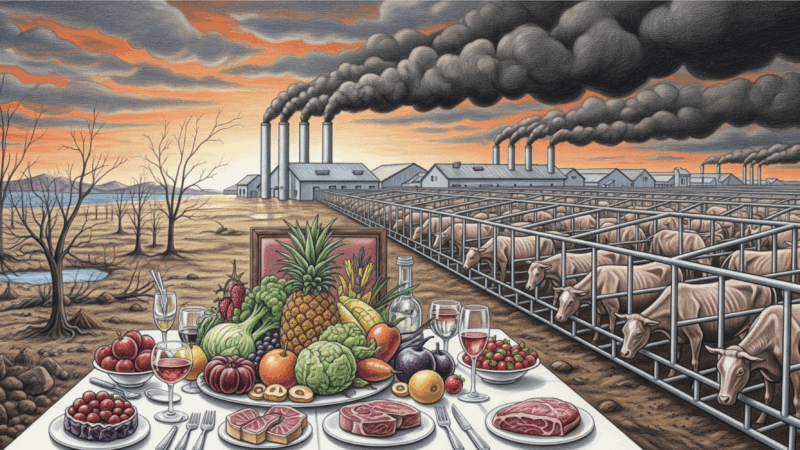
Humanity’s growing demand for animal meat is driving a planetary crisis, accelerating climate change, devastating ecosystems, and threatening public health.
Two grim, almost surreal, 26-story buildings tower over the southern outskirts of Enzhou, about 500 miles west of Shanghai in China’s Hubei province. No one would mistake them for apartment complexes despite their neat grid of window-like slots. Indeed, their main inhabitants are not human at all. The buildings are designed specifically to meet the biological and reproductive needs of 600,000 pigs each. Here they will be bred, farrowed, fattened, and finally slaughtered to meet the exploding animal protein needs of China, which consumes half the world’s pork and is also its biggest pork producer.
It is the world’s largest vertical pig farm, designed to manufacture 54,000 tonnes of pork every year. The building’s design reflects its unique function. Each of its six giant elevators can hoist a load of 10 tons, or about 100 pigs, at a time. Every utility and process, from the building’s water supply, electricity, and air conditioning, to its automatic feeding machines and smart air filtration and disinfection systems, can be monitored and controlled centrally from a NASA-like command center on the first floor. A stupendous amount of pig manure is processed daily in a biogas-driven waste treatment system and turned into electricity for lighting and heating the buildings. About 400 such ‘pig-rises’ could meet a part of China’s and the world’s growing appetite for animal proteins.
Reforesting the Planet, Restoring the Future
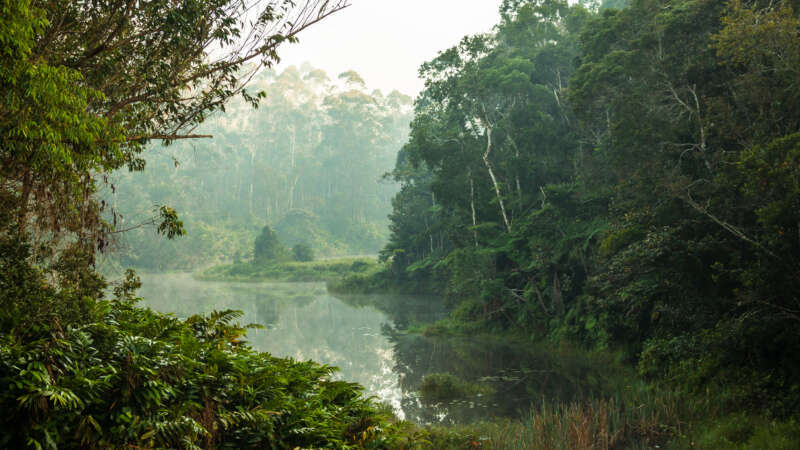
The preservation of the planet’s biodiversity relies entirely on how we manage and interact with the world’s forests.
Reforestation is a critical strategy for mitigating climate change because it increases the Earth’s capacity to absorb carbon dioxide (CO₂) – the main greenhouse gas driving global warming – while also enhancing ecosystem resilience.
In particular, we look at recent studies investigating the most cost-effective approaches to reforestation and the mitigation of climate change. For many years, forest managers have been asking which is best: allowing forests to naturally regenerate, on the one hand, or to plant new forests?
The Role of Technology in Forest Management
In Brazil’s Pará region, new roads are cutting through the pristine Amazon rainforest, opening up once-untouched areas to human activities. Expansive stretches of lush greenery are vanishing at an alarming pace, yielding to barren patches and freshly cleared land.
Meanwhile, far into space, the European Space Agency captures high-resolution satellite images of the region that unveil an important pattern: deforestation occurs predominantly near these newly constructed roads.
Back in 2016, it sparked a question: what if there were a tool to monitor these roads and forecast potential deforestation areas? Not long after PrevisIA was born.
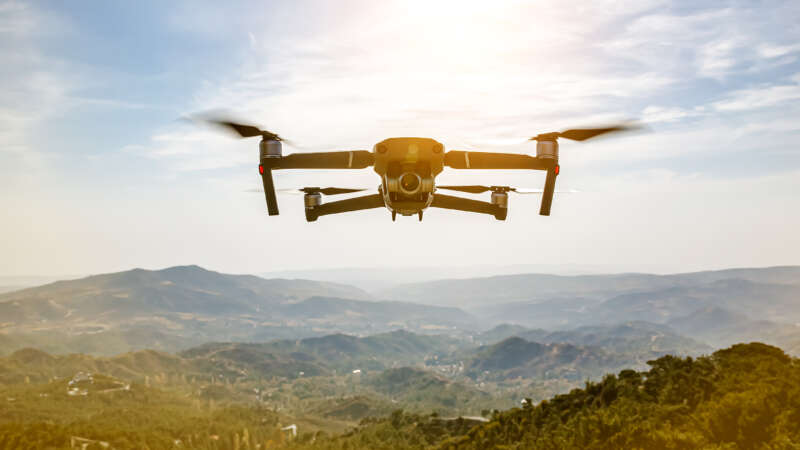
In 2021, Microsoft with Vale Fund and the Amazon Institute for Man and the Environment (Imazon) developed a new AI tool called PrevisIA, to predict deforestation hotspots in the Amazon. Using satellite imagery from the European Space Agency and an algorithm developed by Imazon, the tool produces heat maps showing the most exposed conservation areas, Indigenous lands, and other settlements, along with rankings for states and municipalities.
Indigenous Peoples’ Role in Protecting Forest Health
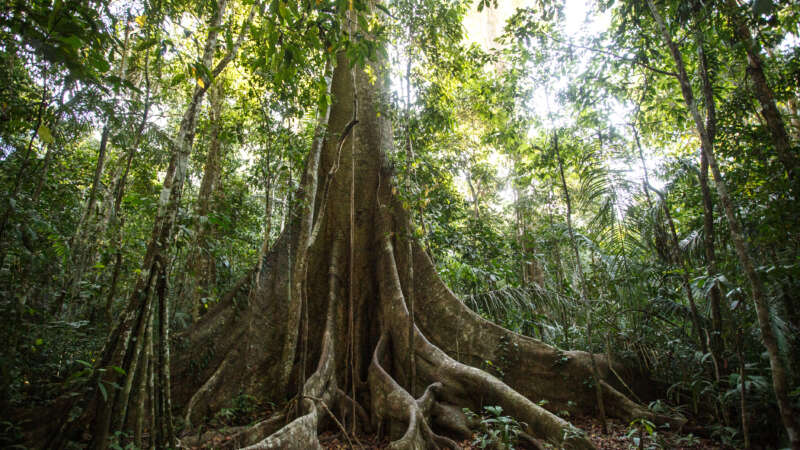
Nearly a quarter of the world’s population, or about 1.6 billion people, depend on forest resources to sustain their livelihood. This number includes an estimated 60 million who are members of indigenous groups. The worldviews of most indigenous cultures include a sacred obligation to serve as stewards of a healthy forest that can sustain its inhabitants for generations.
Indigenous peoples have been effectively managing their forests since “time immemorial,” yet governmental and scientific forestry experts have only recently begun to seek out the knowledge that indigenous peoples have about environmental management.